Block Your Calendar Before Someone Else Does
The short answer
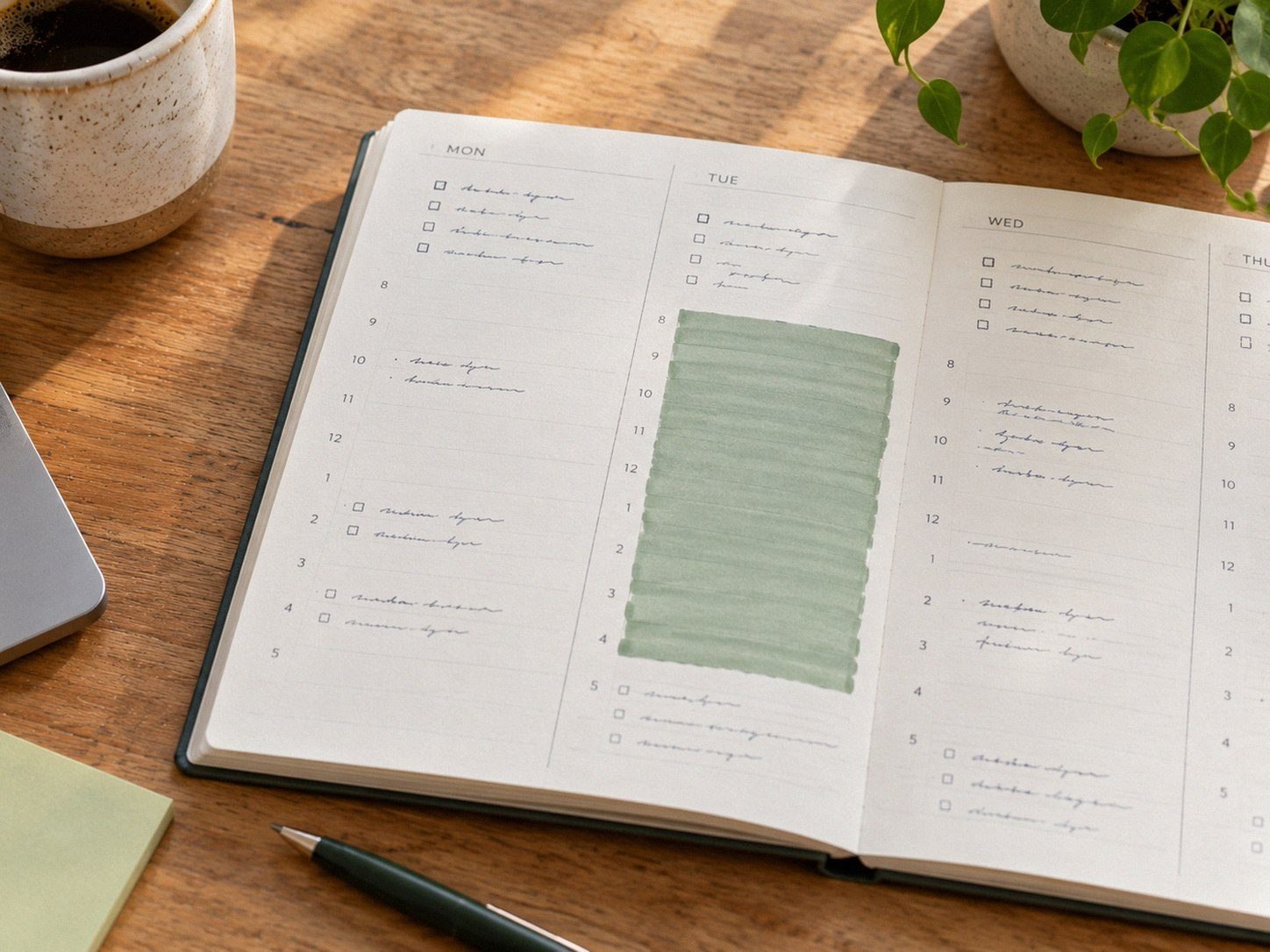
Protecting non-clinical time comes down to treating your calendar like your inbox: if you leave it open, other people fill it. Book the time you need to work on the practice as a recurring appointment, before the clients and the meetings go in, and defend it the way you would defend a client booking. An empty slot is read by everyone, including you, as available.
Why does an open calendar fill with other people's priorities?
A calendar with gaps in it is an invitation. A clinician needs a supervision slot, a referrer wants a meeting, a family asks for a call, and each of those lands in a free hour. None of them is unreasonable. But the sum is a week with no room in it for the work only you can do: the planning, the systems project, the pricing decision, the hire.
Planning and focused work need multi-hour stretches, and those stretches do not appear on their own in a practice. If you wait for a free afternoon to work on the business, you will wait a long time, because the free afternoon gets booked the moment it exists. The time has to be claimed in advance, before it is a gap someone else can see.
There is a psychological trap here too. An unbooked hour feels like slack, like a buffer you are keeping in case something comes up. So when something does come up, you give the hour away without much thought, because it was never really allocated to anything. A block with a specific title on it feels different: giving it away feels like cancelling a commitment, which is exactly the friction you want. The calendar entry is not just a reminder, it is a small promise to yourself that is harder to break than a vague intention.
Protecting non-clinical time: how do you block it?
Put the time in your calendar as a real appointment, with a title that says what it is for. Not “busy” or “admin”, which invites people to ask you to move it, but “Practice, quarterly plan” or “Draft the OT job ad”. A specific title reminds you what the block is for and makes it harder to give away casually.
Start with two hours on three mornings a week, before ten. If that is not possible because you are still nearly full-time clinical, start with one hour on one fixed day, and grow it as you hand clinical work over. The regularity matters more than the total: the same slot every week, held, is what the team learns to plan around, and a predictable block that people can work with beats a larger one that moves around and catches everyone by surprise.
Book the block at least a fortnight ahead, further if your diary fills early. If you only try to protect next week’s block next week, the clients and meetings are already in and there is nowhere to put it. Blocking a recurring slot months out, and then releasing individual instances only when you genuinely must, is far easier than carving out the time week by week.
Also block the edges of the day if you need them. If you are trying to leave at five to see your family, a recurring “unavailable after 4:30” block does more than good intentions, because it is visible when someone tries to book you, and it gives you something concrete to point to when a request would push you past it. The same goes for a genuine lunch break, which is the first thing to disappear in a busy practice and the easiest to protect once it is an entry in the calendar rather than a hope.
How do you defend it?
The test for whether to give up the block is the same as for a client booking: would you cancel a client for this. A staff question, an email, a referrer who wants to meet this week rather than next: none of those clear that bar. A genuine emergency does, and when it takes the block, you rebook it into a specific slot the same day, not “sometime soon”. A block that gets bumped without being rebooked quietly stops existing, and after a few weeks of that the practice-building work has disappeared from your calendar entirely.
Keep a simple count, for a month, of how often you kept the block and how often you gave it away. Owners are usually surprised by the ratio. If you are keeping it less than half the time, the problem is not the calendar, it is that you have not actually decided this work matters, and that is a conversation to have with yourself or a peer before anything else changes.
Defend it from yourself too. The block fails as often because you open your inbox “just to check” as because someone interrupts. Treat the two hours as genuinely unavailable, with the email tab closed and the phone in a drawer.
It also helps to protect the block from your own sense that everything else is more urgent. Almost anything can be made to feel like it needs doing right now, and if you let that feeling win every week, the block never survives. The discipline is to notice the pull, decide that the small urgent thing can wait ninety minutes, and stay on the task. After a few weeks this gets much easier, because you have proof that the world did not end while you were unavailable.
Telling the team
A protected block the team does not understand reads as you being mysteriously unavailable. A protected block the team does understand reads as normal. Say it once, plainly: “I am not available before ten on Tuesday, Wednesday and Thursday unless something is genuinely on fire, because that is when I work on the practice.” Then hold to it, and within a fortnight the team saves their non-urgent questions for after ten without being reminded.
If you have a shared calendar, make the blocks visible on it, so people can see the pattern rather than running into it. Visible constraints get respected. Invisible ones get ignored.
One more thing to say to the team: the block is not you being unavailable to help, it is you doing the work that makes the practice better for all of them. When a clinician understands that you used the Tuesday morning block to design the new grad programme they asked for, or to run the pay review, the block reads as you doing your job rather than hiding from theirs. Frame it that way once and most teams protect it for you.
Where this fits
This week, put three two-hour blocks in your calendar for the mornings, title them with the specific work they are for, and tell your team. Defend them for a fortnight. The Practice Health Check will help you decide what those blocks should be spent on. Protecting non-clinical time is a direct application of the guide to running the practice instead of letting it run you, decided by big rocks first, protected the same way the morning inbox habit protects when to check email as a practice owner, and reviewed each week in the weekly review.